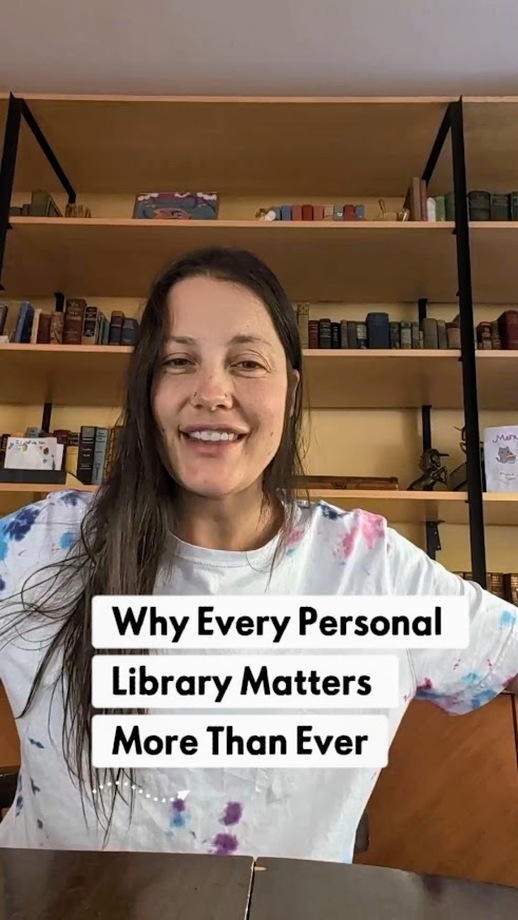
I recently took a short break from preparing for the Pagan Fair to talk about something that has been weighing on my mind.
Recent reporting has brought attention to AI companies and their intermediaries purchasing physical books in enormous quantities for AI training data. Books are being bought by the thousands, including older, used, rare, obscure, and out-of-print titles.
Many of these books are then processed through destructive scanning methods. Their bindings are cut away, individual pages are fed through high-speed scanners, and the physical copies may then be recycled or discarded because they cannot be put back together again.
This is what concerns me.
These are not simply one or two books being carefully digitized for preservation. Physical books are being purchased in bulk as material for digital datasets. And while not every book being acquired is rare or irreplaceable, the scale of this demand has the potential to affect the used, antiquarian, and out-of-print book market.
As someone who has spent much of her life collecting, selling, and loving old books, I find myself thinking about what can be lost when a physical book disappears.
And in my personal opinion, the destruction of physical books in this process represents a modern-day form of book burning.
I do not mean that every company involved has the same intentions, or that this is identical to the historical destruction of books by governments or ideological groups. But the result that concerns me is still the same: physical copies of books are being intentionally destroyed.
My Thoughts in This Video
In this video, I share my thoughts about AI companies purchasing physical books in bulk, the destructive scanning of those books, and why I believe building a personal library has become more important than ever.
But more than anything, this is a conversation about preservation—and about the importance of collecting the things you truly love.
There is another part of this that troubles me.
Once a physical book has been scanned and destroyed, we are not guaranteed that the digital version will be freely available to the public. The information may become part of privately controlled datasets. We have no guarantee that a scanned book will simply be placed online for everyone to read.
And what happens to that information after it enters a system we do not control?
Could it be altered? Could portions of it be changed, omitted, or used in ways the original author never intended? Could access to information that once existed inside a physical book eventually be controlled, restricted, or even sold back to us?
I cannot predict exactly what will happen. But these are questions I believe we should be asking before we become comfortable with physical books being treated as disposable.
A book is so much more than the words printed on its pages.
Its binding tells part of its story. Its illustrations reflect the time in which it was created. An inscription can connect us to someone who held the book decades ago. Marginal notes can reveal the thoughts of a previous reader. Even the wear on a book—the softened edges, the aging paper, the marks left by time—becomes part of its history.
When we reduce a physical book to nothing more than the information contained within its text, we lose sight of everything else it carries.
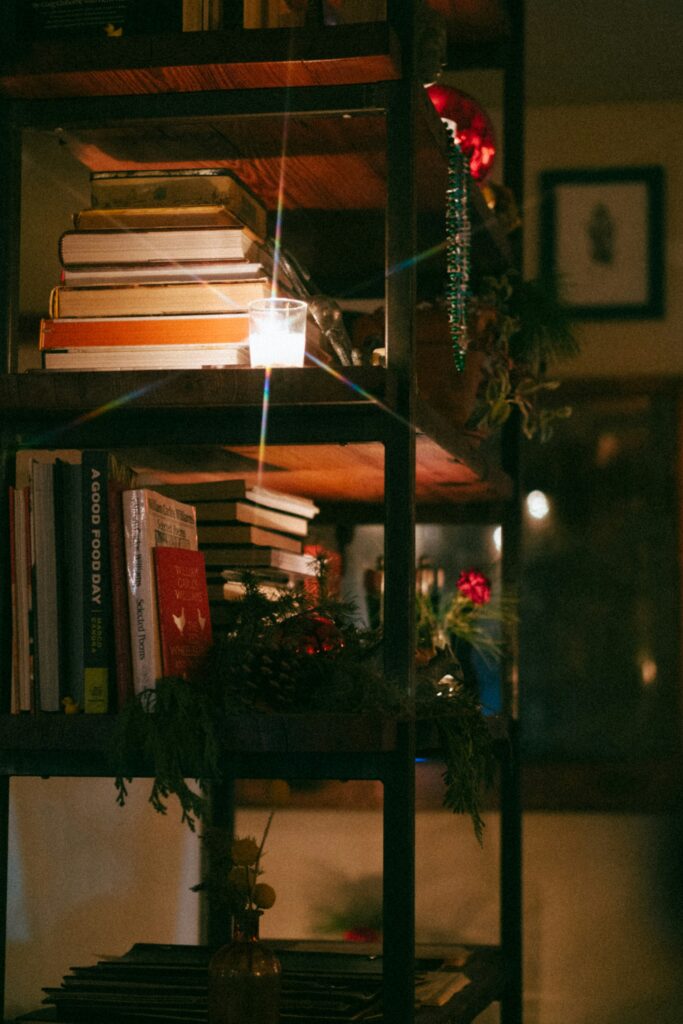
And this is why I believe collecting the things we love matters more than ever.
You do not need to be an antiquarian bookseller or a serious collector to build a personal library. You do not need shelves filled from floor to ceiling or expensive first editions.
A collection can simply begin with the things you love.
The books that changed the way you think.
The books you return to again and again.
The books that remind you of a particular time in your life.
The books you hope someone else might someday discover on your shelf.
When you choose to keep something, you are doing more than simply owning it.
You are helping to preserve it.
You are keeping it in the world.
Perhaps this is a good time to begin—or continue—building a personal library filled with books that truly mean something to you. Not because every book will become rare or valuable, but because the things we choose to keep tell the story of what mattered to us.
Keep the books you love.
Read them.
Re-read them.
Share them.
Pass them on when the time is right.
Because every physical book we preserve is one more piece of history, knowledge, art, or human experience that remains in the world.
꧁ 🦉📚 ꧂
A Quote Inspired by This Conversation
I think this topic is important enough that I tailored my recent Quote of the Week poster around it.
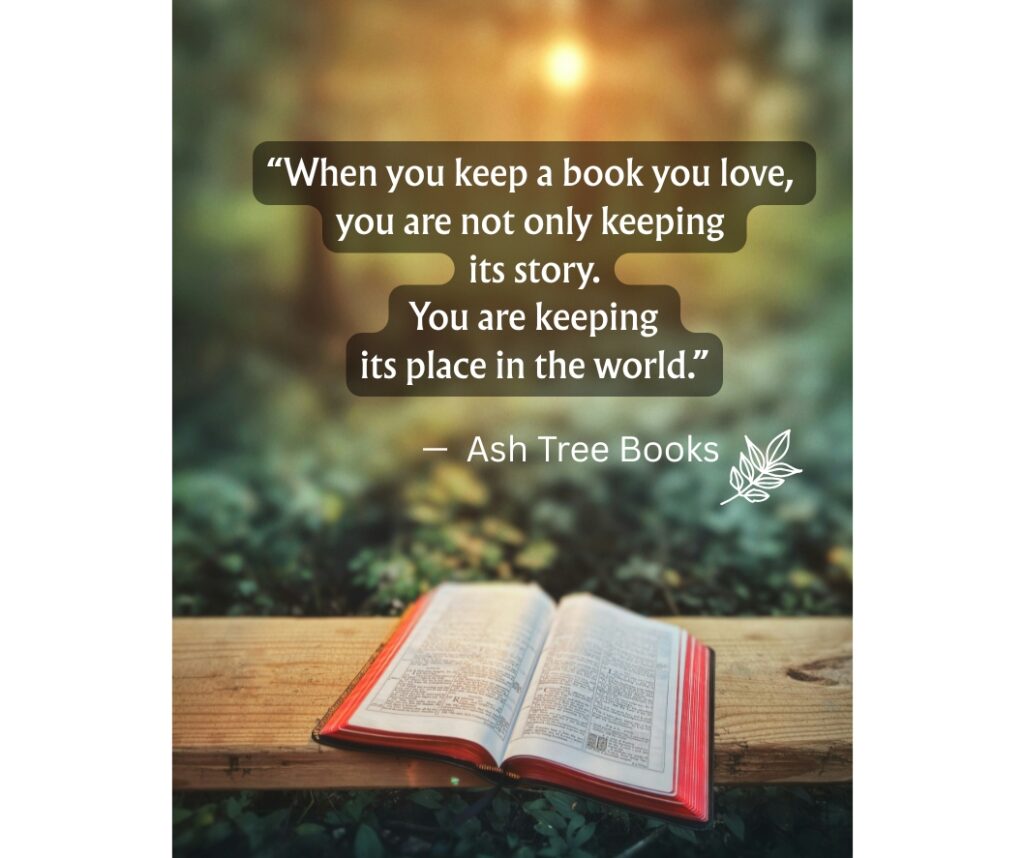
“When you keep a book you love, you are not only keeping its story. You are keeping its place in the world.”
— Ash Tree Books
A home filled with books is a home that remembers. ⋆。°✩ 📚 ✩°。⋆
If you love celebrating the magic and love of books and reading, you can explore the Quote of the Week category on Ash Tree Books—a little spark for every book lover’s heart.
📚 Explore the Quote of the Week Collection → Quote of the Week | Ash Tree Books
༺ 📖 ✦ 📚 ✦ 📖 ༻
I’d Love to Hear Your Thoughts
This topic feels more important to me than ever.
Do you have a growing personal library? Is there something you love to collect and preserve?
In a world where so much is becoming digital, automated, and disposable, I think there is something meaningful about choosing to keep the things we love.
I’d truly love to hear your thoughts on this topic.
And perhaps I’d also love to know:
What are you keeping in the world?
— Ash
🌳 Ash Tree 📚 Books ᛉ